Sing Loudly, Bow Politely: A Novice’s Field Guide to the January Orchard Wassail
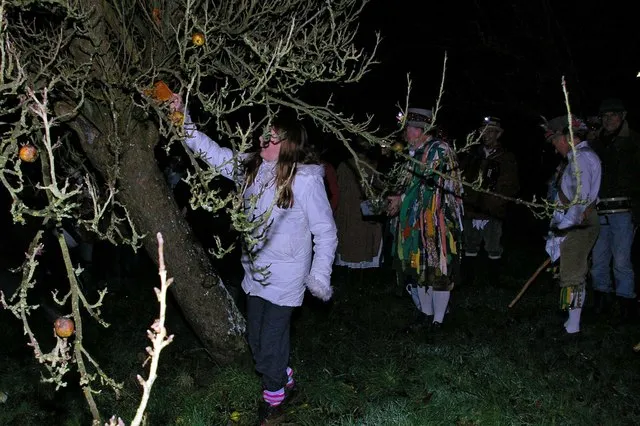
Photo: Glyn Baker, CC BY-SA 2.0, via Wikimedia Commons
January is a month with all the charm of a wet dog. The decorations are down, the credit card statement has landed, and the only remaining source of joy is the thought of spring. Which is precisely why the orchard wassail exists: an excuse to gather in a muddy field, drink hot cider, sing badly at a tree and pretend this is an ancient agricultural duty rather than a very good night out.
It is also, if you have never been to one, slightly baffling. There is toast involved. There is shouting. In some villages there is a shotgun. Here is everything you need to know to wassail with confidence, or at least with the appearance of confidence after one mug of mulled cider.
What on earth is a wassail, and why is there bread in a tree?
The word comes from the Old English waes hael, meaning “be in good health” — the sort of thing you say before drinking, and then repeat loudly until someone gives you a refill. Over centuries it attached itself to a winter custom: visiting orchards in the depths of January to wake the apple trees, scare off bad spirits and encourage a decent crop in the year ahead.
The toast is the bit that puzzles newcomers. A slice of bread is soaked in cider, sometimes studded with cloves or dipped in honey, and hung from a lower branch of an apple tree. It is an offering, not a snack. Birds are supposed to eat it. You are not. Eating the tree’s toast is the wassailing equivalent of eating the decorations.
Other regional variations include pouring cider around the roots of the tree, banging pots and pans, singing, cheering, and — in a few West Country villages — firing shotguns through the branches. Modern community wassails tend to keep the gunfire optional or symbolic. Check before you bring your own percussion section.
A very short history, because you’re here for the cider
Wassailing has roots in pre-Christian midwinter customs, but the orchard version we know today is a thoroughly British muddle of folk tradition, Victorian revivalism and twentieth-century community spirit. It flourished in the cider counties — Somerset, Devon, Herefordshire, Worcestershire, Kent, Sussex — where apples paid the rent and a bad harvest was a genuine disaster.
The traditional date is Twelfth Night, 5 January, or Old Twelfth Night on 17 January for those keeping the Julian calendar and a stubborn grip on the old ways. In practice, many modern wassails happen on the nearest weekend, which is helpful if you have a job, a train to catch or a low tolerance for standing in a field on a Monday.
The etiquette bit: how not to be That Person
Wassails are friendly, but they are still somebody’s orchard, somebody’s village and somebody’s ancestors. A few ground rules will keep you on the right side of the cider maker.
Bring a mug, not a drone. A decent enamel mug is ideal; a thermos is acceptable. A drone buzzing over the blessing is not. The point is human noise, not aerial footage.
Learn one song. “Here We Come A-Wassailing” is the safe bet, followed by any local variant someone shouts at you. Do not launch into a sea shanty. Do not attempt a solo. The wassail is a chorus, not an audition.
Don’t pre-load. The toast is the point, not the pre-drinks. Arrive reasonably sober, drink the mulled cider at a pace that suggests you have met alcohol before, and save the serious sampling for afterwards.
Ask before you photograph. Some wassails are public; some are private orchard gatherings that appear in a parish newsletter and nowhere else. If in doubt, ask. And do not post the exact location of a private orchard on social media. The trees have enough to cope with.
Respect the tree. Do not climb it, shake it, strip bark from it or try to take the toast home as a souvenir. In January the tree is dormant, not dead, and it has a job to do.
Join the bow. When the tree is blessed or addressed, take your hat off, keep quiet and follow the lead of the people who clearly know what they are doing. It lasts about a minute. You can manage a minute of reverence.
Buy something. If the orchard sells juice, cider or apples, buy a bottle. It is the easiest way to say thank you and the most delicious way to fund next year’s wassail.
The wassail bowl: a recipe that won’t disgrace you
You do not need a cauldron, a spice grinder or a family recipe from 1743. You need cider, heat and a certain generosity with the honey.
Scrumpi’s lazy wassail bowl
- 1 litre dry or medium-dry British cider
- 250ml cloudy apple juice
- 2 tbsp honey, or more if the cider is very dry
- 1 cinnamon stick
- 3 cloves
- 1 star anise
- A strip of orange peel
- A thick slice of white bread, for the tree
Warm the cider, apple juice, honey, spices and orange peel in a saucepan over a low heat. Do not boil it — you want mulled, not murdered. Taste, add more honey if needed, and keep it warm. Toast the bread, soak it briefly in a little cider, and hang it from a low branch when you get to the orchard. If you are hosting at home, put the bowl on a table, provide mugs and let people help themselves. A splash of brandy is traditional in some households and entirely optional.
Where to go: orchards worth a January drive
Carhampton in Somerset claims one of the oldest continuous wassails in the country, held on Old Twelfth Night. Ramsbury in Wiltshire puts on a properly lively affair. Brogdale in Kent, home of the National Fruit Collection, is a fine place to learn the difference between a wassail and a wake. Westons in Herefordshire, Sheppy’s in Somerset and Aspall in Suffolk all have cider credentials and occasional wassail events. Community orchards, National Trust properties and city farms increasingly host their own versions, which are often smaller, muddier and easier to get a mug at.
Dates vary, so check before you travel. Many happen on the first weekend after Twelfth Night, others on 17 January, and a few on whatever Thursday the parish council could agree on. Book a taxi if you are going deep into cider country. January lanes and a wassail bowl are not a combination that rewards optimism.
The morning after
You have sung to a tree. You have hung toast in a hedge. You have drunk hot cider from a mug that may once have held tea. You have done something ancient, faintly ridiculous and quietly useful: you have reminded yourself that apples are not just a supermarket product but a crop with a calendar, a community and a very good excuse for a party.
That is the point of wassailing. The toast is just the beginning.